
From DevOps to DevSecOps: Integrating Security into Your Development Pipeline
How to move from DevOps to DevSecOps: what changes, why it matters, and how to embed security into every stage of your development pipeline.
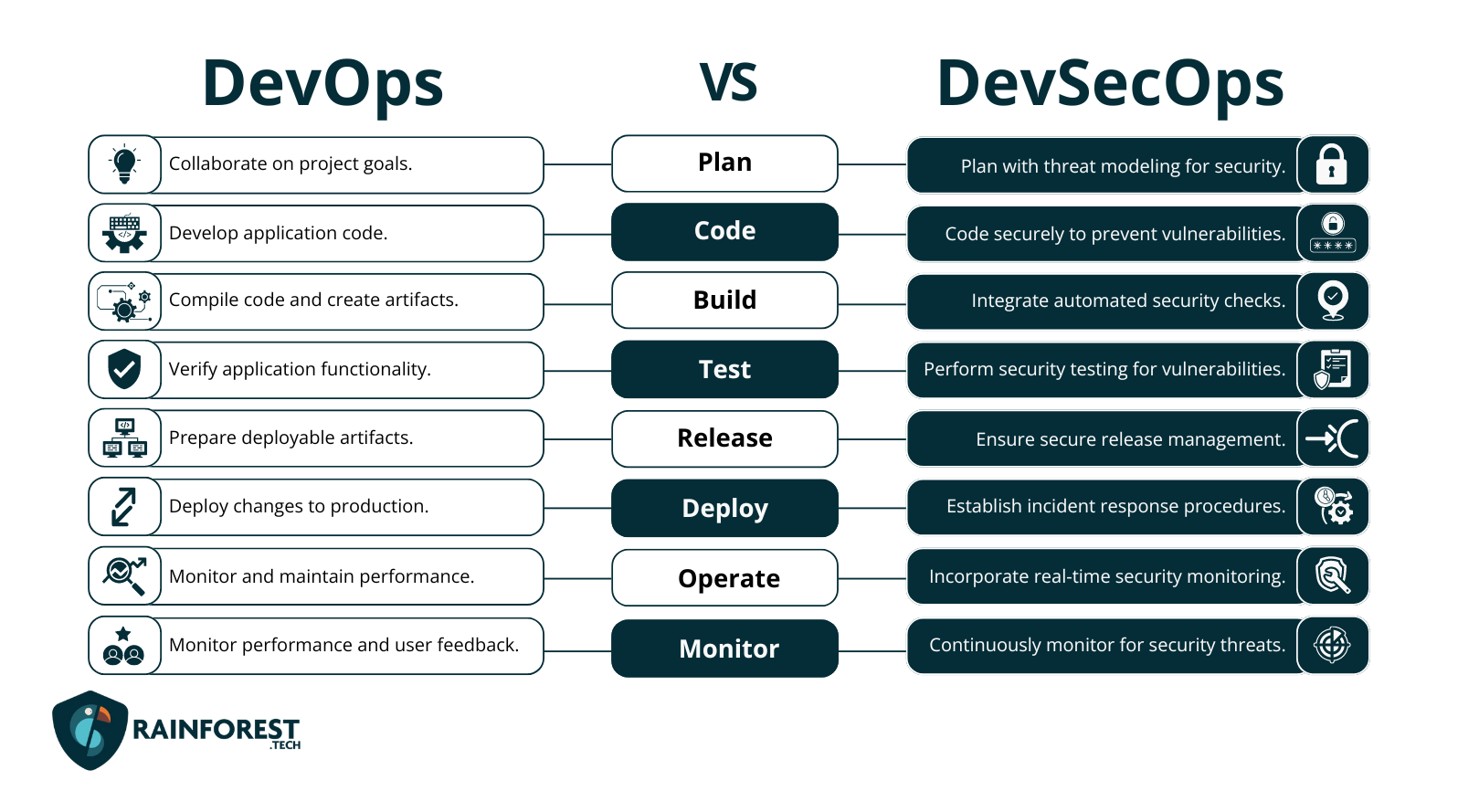
Traditional end-of-cycle security methods aren't enough. Enter DevSecOps: it integrates security into the DevOps process at every stage, boosting both security and efficiency. This post shows you how to incorporate security seamlessly into your development process, tackle common challenges, and find practical solutions. For the broader picture of how these practices fit together, see our guide to application security.
What's the difference between DevOps and DevSecOps?
DevOps is a blend of "Development" and "Operations." It's all about bringing software developers and IT operations together to work better as one team. The focus is on making software delivery faster, more reliable, and higher quality.
DevOps emphasizes collaboration, automation, and continuous improvement. Key practices include continuous integration, continuous deployment, and treating infrastructure as code.
DevSecOps builds on DevOps by adding a security focus. The idea is to make security everyone's responsibility throughout the software lifecycle, from planning to deployment. Instead of dealing with security issues after software is built, DevSecOps encourages teams to address them early on.
This means using automated security testing, threat modeling, and continuous monitoring. The goal is to prioritize security without sacrificing speed or innovation.
DevOps focuses on improving collaboration between development and operations teams to deliver software quickly and efficiently. DevSecOps does this too, but adds security into the mix, focusing on secure coding, automated security tests, and proactive threat management.
Despite these differences, both DevOps and DevSecOps value cross-functional teamwork, continuous improvement, and automation. The key evolution with DevSecOps is integrating security into the DevOps culture to produce secure, high-quality software.
Why is DevSecOps needed?
Software development environments are increasingly threatened by sophisticated cyber attacks. These attacks exploit vulnerabilities in the development pipeline, from code repositories to build servers, aiming to compromise sensitive data or disrupt services. The increased use of third-party libraries and open-source software in modern development has broadened the attack surface, making it crucial for organizations to address these risks proactively.
Several high-profile breaches have highlighted the consequences of inadequate security practices in software development. For instance, the SolarWinds attack exploited a vulnerable build system, leading to widespread compromise.
Similarly, the Equifax breach, caused by a failure to patch a known vulnerability, exposed the personal data of millions. Implementing DevSecOps practices, such as automated security checks and continuous monitoring, could have helped identify and mitigate these risks early.
Proactive security measures in development offer numerous benefits, helping organizations stay ahead of evolving threats. These measures enable teams to address vulnerabilities early, reducing the likelihood of costly breaches and minimizing the impact of potential incidents.
Benefits include:
- Improved code quality: identifying and fixing security issues during development results in cleaner, more secure code.
- Reduced time and cost: addressing security concerns early in the development process avoids expensive remediation later.
- Enhanced customer trust: demonstrating a commitment to security builds customer confidence and enhances reputation.
- Faster time to market: integrating security into the development process allows for quicker, safer releases.
- Regulatory compliance: implementing security best practices helps organizations meet regulatory requirements and avoid penalties.
How to integrate security into the DevOps cycle
The DevOps pipeline consists of several stages that help manage the software lifecycle efficiently:
- Plan: define project goals, requirements, and strategies.
- Code: write and review code, implementing the planned features.
- Build: compile the code into a functional application.
- Test: validate the application through various testing methods.
- Release: prepare the application for deployment.
- Deploy: deliver the application to the intended environment.
- Operate: maintain and manage the application post-deployment.
- Monitor: track the application's performance and detect issues.
Integrating security practices
Security should be embedded in every stage of the DevOps cycle to prevent vulnerabilities from slipping through. Implementing security practices and leveraging the right tools at each stage ensures that applications are secure from start to finish.
Secure planning: threat modeling and risk assessment
During planning, threat modeling identifies potential security threats by mapping out possible attack vectors. This step allows teams to understand where their applications might be vulnerable and what assets are at risk. Risk assessment then prioritizes these threats based on their likelihood and impact, enabling teams to focus on mitigating the most critical issues.
Secure coding: implementation of secure coding practices and tools
Secure coding involves adhering to best practices, such as input validation, avoiding unsafe functions, and using secure APIs. Static analysis tools such as SAST scan the codebase for potential security flaws, helping developers identify and address issues before they become problems.
Secure building: secure build processes and automated security checks
Secure build processes ensure that only trusted code is compiled. This often involves using controlled build environments and verifying the integrity of dependencies. Automated security checks, like software composition analysis, identify vulnerabilities in third-party libraries used during the build, preventing insecure code from entering the application.
Secure testing: integrating security testing (SAST, DAST) into CI/CD pipelines
Security testing should be integrated into CI/CD pipelines. SAST scans the source code for vulnerabilities before executing the application, while DAST tests the running application for security issues. If you're weighing when to use each, our comparison of SAST vs DAST breaks it down. By embedding these tests into CI/CD pipelines, teams can detect and fix vulnerabilities continuously, ensuring that security remains a priority throughout development.
Secure release and deployment: secure release management and deployment automation
Secure release management involves verifying the integrity and authenticity of release artifacts. Automated deployment tools can ensure that the right code is deployed to the correct environment, reducing the risk of human error or unauthorized changes.
Secure operation: continuous monitoring and incident response
Continuous monitoring involves tracking system performance, network activity, and user behavior for potential security issues. A robust incident response plan prepares teams to address breaches swiftly and minimize their impact. This includes having predefined procedures for identifying, containing, and eradicating security incidents and recovering from them.
Secure monitoring: real-time security monitoring and logging
Real-time security monitoring and logging are crucial for detecting and responding to threats. Monitoring tools track system and network activity, while logging provides detailed records of system events and user actions. These logs are invaluable for investigating security incidents, identifying root causes, and developing measures to prevent future issues.
Challenges and solutions in DevSecOps adoption
Adopting DevSecOps can feel daunting, but understanding the common challenges makes the journey smoother. Many organizations face hurdles such as cultural resistance to change, a shortage of skilled personnel, difficulties integrating new tools with existing ones, and the complexities of scaling security practices. Let's explore each challenge and how to tackle it effectively.
Cultural resistance to change
Change can be tough. When adopting DevSecOps, people often resist shifting away from traditional methods. This resistance can slow down the adoption process and create friction within the team.
Solution: implement gradual change management. Taking small, manageable steps makes a difference. Introduce DevSecOps practices gradually to help everyone adjust without feeling overwhelmed. Clear communication about the benefits, along with ample support and training, can ease the transition and make it a positive experience for everyone involved.
Lack of skilled personnel
Finding the right people with expertise in both development and security can be challenging. This skills gap can make it hard to integrate security seamlessly into the development lifecycle.
Solution: invest in training and development. Offer continuous training programs focused on security and DevOps practices. This not only enhances the skills of your current employees but also attracts new talent eager to learn and grow.
Integration with existing tools
Integrating new security tools with your existing development and operations tools can be tricky. Compatibility issues and the need for customization can slow down the process.
Solution: choose tools with extensive integration capabilities. Look for security tools that play well with others and offer robust integration with your existing setup. Prioritize tools that are easy to use and support popular CI/CD platforms, making the integration process as smooth as possible. A unified application security testing platform reduces this friction by consolidating multiple scanners behind one integration.
Scaling security practices
As your organization grows, scaling security practices across multiple teams and projects can become increasingly complex. Keeping consistent security measures in place can be a real challenge.
Solution: adopt modular security solutions. These can be customized to fit the specific needs of different teams and projects, providing both flexibility and consistency. By using modular security measures, you can ensure comprehensive coverage while allowing individual teams to manage security in a way that suits their workflows.
Conclusion
We've covered the basics of DevSecOps, the need for a security-first approach, and how to integrate security practices at each stage. While initial challenges exist, the benefits are immense. You can build a strong, secure development pipeline by promoting collaboration, continuous training, and scalable security solutions.
Ready to secure your development process with DevSecOps? Book a demo to see how our platform can integrate security seamlessly into your workflow.
Frequently asked questions
What is the difference between DevOps and DevSecOps?
DevOps unites development and operations to deliver software faster and more reliably through collaboration, automation, and continuous integration and deployment. DevSecOps builds on that by making security a shared responsibility across the whole lifecycle — adding automated security testing, threat modeling, and continuous monitoring so security keeps pace with delivery instead of being bolted on at the end.
Why is DevSecOps important?
Modern pipelines are a target, from code repositories to build servers, and heavy use of open-source and third-party components widens the attack surface. DevSecOps catches vulnerabilities early, when they are cheapest to fix, which lowers breach risk and remediation cost, builds customer trust, speeds up safe releases, and helps meet regulatory requirements.
How do you integrate security into a CI/CD pipeline?
Embed security at each stage: threat modeling in planning, secure coding standards and SAST while coding, dependency and composition analysis at build, SAST and DAST in the CI/CD pipeline during testing, integrity checks at release and deploy, and continuous monitoring and logging in operation. Automating these checks keeps security continuous rather than a late-stage gate.
What are the main challenges of adopting DevSecOps?
The most common are cultural resistance to change, a shortage of people skilled in both development and security, integrating new tools with an existing toolchain, and scaling consistent practices as the organization grows. Gradual change management, ongoing training, well-integrated tooling, and modular security solutions address each in turn.

Written by
Bruno Baldo
CMO
Um pouco de marketing e um pouco de curiosidade e temos a receita pra criar um apaixonado por cyber!
What Is Application Security (AppSec)? The Complete Guide
What application security (AppSec) is, why it matters, the core testing types (SAST, DAST, SCA), how it fits the SDLC, the OWASP Top 10 (2025) and best practices.
SAST vs DAST: The Differences and When to Use Each
SAST vs DAST explained: how static and dynamic application security testing differ, when to use each, and why mature AppSec programs run both.